Updated after my last post: I've just read that the FA is now planning on delaying its decision to announce the results of the QPR/Faurlin inquiry until next week, after the final round of Championship games has been played.
Words fail me with how the governing body have handled this whole situation from beginning to end.
More to follow.
Thursday, May 05, 2011


Bluebirds blow-out leaves FA with escape route for QPR case
Cardiff City's collapse to Middlesbrough in the final home game of the season not only ruined the club's automatic promotion hopes but may have given a perfect opportunity for the FA to escape its QPR dilemma.
The case involving Queens Park Rangers' purchase of Alejandro Faurlin is likely to be settled today with any punishment, if the club is found guilty, also handed out.
Speculation has been rife that QPR has already be found guilty of breaching and that a substantial penalty, possibly up to 15 points, will be applied.
And this is where the effects of Bank Holiday Monday's first-half nightmare could play a very significant part.
The Bluebirds' 3-0 horror show defeat ensured that Norwich City's subsequent 1-0 away win at Portsmouth guaranteed a place in the Premier League next season for the East Anglia club.
As a result with just one game left to play QPR are champions (subsequent to the FA inquiry) with a five point lead over Norwich who are a further four points ahead of Cardiff.
And this gap is crucial.
Had Cardiff beaten the visitors and Norwich repeated the result that would have left the Bluebirds trailing the Canaries by just one point and QPR by only six.
Effectively this would have cut off an easy route to punish the London team had they been found guilty.
Now however, should the FA decide QPR need to be penalised severely, it can dock seven or eight points and be comfortable in the knowledge that if all QPR win the season's final game promotion will be secured, albeit minus the glory of a champions trophy.
Doing this would also prevent major disruption to the league standings and playoff picture and hence likely avoid the potential myriad legal challenges such a move would prompt.
Of course, the FA could decide to just enact a massive fine but no points deduction, effectively ok-ing QPR's actions and ensuring promotion.
Or it could take an incredibly severe option and simply invalidate the club's promotion (effectively demoting it back to the Championship) and enforce one less relegation from the Premier League this season to maintain continuity of that structure.
Either of those methods would also involve a minimum of interference in league standings, and a reduced relegation count is unlikely to be objected from the Premier League clubs, but they lack the often desired 'Goldilocks factor'.
This new opening provides an outcome that could be 'just right'.
Wednesday, November 24, 2010
Djokovic's finals ambition blinded by a contact lens
A slipped contact lens cost Novak Djokovic the chance to beat top ranked Rafael Nadal and secure a place in the semi-finals of the Barclays ATP tennis finals.
Instead the world number one powered to a comfortable 7-5 6-2 victory and claimed pole position to qualify from group A with one round robin match left.
It could have been so different but for the Serb's eye wear malfunction that visibly affected his game and from which he never recovered.
The match began with some sparkling play in the first seven games as the pair pounded ground shots to all corners and each man claimed a break of service.
But the rhythm was broken in the next game as Djokovic's contact lens struck.
At 15-0 to Nadal, the world number three reported the problem and headed to the bench.
However, after receiving assistance and returning to the court he lost the game 40-0 before retreating to the locker room to repair the situation.
Sadly by then the damage was done.
Although both men held serve to make it 5-5, Djokovic was clearly unable to recapture his form and the next three games effectively decided the contest.
First Nadal broke Djokovic and then held his own service game to take the set 7-5 before breaking the tall right hander for the third time to steal the second set initiative.
From then on Nadal dominated as the match occasionally sparked into life with fleeting flashes of fine play from both men reminding the packed O2 arena crowd of what the battle could have been.
By the time the Spaniard broke for the third consecutive time, and fourth in total, it was a case of delaying the inevitable.
Djokovic did engineer a mini-rally to at least add a modicum of respectability to the scoreline but Nadal wasted little time in issuing the last rites.
Speaking after his victory, Nadal acknowledged Djokovic's handicap but was pleased to be at least partly exorcising the ghosts of last year's performance.
Thursday, May 06, 2010
Election 2010: BNP fight among themselves as UKIP comes down to earth with a bump
Regardless of the outcome, General Election Day 2010 has been one of the more memorable polling days in a long time.
It even included the sight of the BNP and UKIP crashing down to Earth before voting had closed.
Prior to the polls opening there was the early morning specter of newspaper front pages forming a kaleidoscope collage of colour and vivid imagery.
To say it was a vivid picture would be an understatement, with most of it highly partisan, and some even bordering on downright propaganda.
That followed rapidly on from a late night revelation, which many say showed the BNP in their true colours.
A fight erupted on the campaign trail between Bob Bailey, London organiser for the BNP, and a local Asian teenager.
The scrap was filmed, and subsequently broadcast on the eve of the election, in what many will hope is a highly damaging revelation for the party, continuing from the all out warfare between Nick Griffin and the party’s webmaster Simon Bennett.
However, its unlikely that many people who were prepared to vote BNP prior to this scandal were likely to change their opinions, and some might even suggest that beating up an Asian boy criticising their policies would probably enhance the BNP's support from those people.
Then, mid-morning, just a couple of hours after polls opened, news filtered through of a plane crash involving ex-leader and standing UKIP candidate Nigel Farage.
Firstly its good to note that both Farage and his pilot, Justin Adams appear to have suffered only non-life threatening injuries.
Maybe more notably though, is something pointed out by The Guardian’s Roger Browning.
On his twitter feed, he identified the problem with Farage’s plan, that if following election protocol would have kept him out of hospital, though possibly out of the media as well.
“Just a thought about Nigel Farage,” he said, “you're not supposed to campaign on election day, so what was he doing up in a plane with a Ukip banner?”
So possibly a politician getting his comeuppance at last?
It has, however, come to my attention that campaigning is allowed on election day, although if the exploits of Labour candidate for Bootle, Joe Benton, is anything to go by, these candidates experiences may end it all together.
According to the BBC, Benton who has held the seat since 1990, had the tip of his finger bitten off by a dog while campaigning.
Sadly though, much of the campaign has been focused on the three leaders debates, particularly so after the kick start that Nick Clegg and the Liberal Democrats received after the first.
It seems the other parties realised if they didn’t play things very carefully there could be a Nick Clegg steamroller heading straight for them.
The media is as much to blame for this too, centering their attentions on the three party leaders, and barely giving anyone else in the parties a second thought - as evidenced by the complete absence of Conservative candidate Phillipa Stroud’s history of claiming to cure people of their homosexuality, although there were whispers of a BBC, ITV and SKY gag on the subject.
But, as a result of the personality debate, and with the scramble for votes reaching its crescendo, the Sun proudly revealed that Simon Cowell, owner and originator of one of the most tedious TV series ever broadcast in Britain, was throwing his weight behind the Conservatives.
That the Sun is owned by Rupert Murdoch, who had also just signed a huge television deal with Cowell for his FOX network in the USA , is of little surprise.
Neither is the fact that Cowell is one of the richest men in the country, and the Conservatives have long been seen as the party of the rich.
Whereas other celebrities, such as Eddie Izzard, came out with their vocal support early in the campaign, actively promoting their choice over the past month, rather than taking one seemingly opportunistic interview to do it.
Personally, I find these celebrity endorsements do little to support the party being promoted, even in the case of Izzard if they are done with clarity and well formed and argued reasoning.
I find it reflects more upon the celebrity themselves, partly about how they conduct themselves “on party business”, and also simply on the party they have chosen.
Because in these circumstances, its not the party that has decided Izzard is particularly funny, or that Cowell’s programmes and music creations are especially entertaining – it is the celebrity that has said they agree with that party's policies.
And thus, far more can be understood about a person’s character by the political party they openly choose to support, than the party they have chosen.
The party has, in effect, no say in the matter.
And from this is something that both saddened and disappointed me.
Standing in my constituency of Richmond Park (presently held by the Liberal Democrats' Susan Kramer), is Zak Goldsmith.
His name maybe familiar to many of you.
Goldsmith is the former editor of the Ecologist magazine, a publication that by its very name, shows the intent to support the environment and nature, and he was, until recently a regular contributor to the BBC’s popular political debate show Question Time as one of the non-politically aligned speakers.
From this point of view, and his opinions voiced on the BBC, I believed he would be most closely aligned to a party with a strong ethical and societal background, perhaps the Liberal Democrats or Green Party.
Apparently I was mistaken.
He's chosen a party, the Conservatives, that has a limited environmental policy and an attitude towards the weaker and lower members of society that seems unconcerned at best and derisory at its worst.
The Conservatives have not changed in my mind, but Zak Goldsmith has.
It even included the sight of the BNP and UKIP crashing down to Earth before voting had closed.
Prior to the polls opening there was the early morning specter of newspaper front pages forming a kaleidoscope collage of colour and vivid imagery.
To say it was a vivid picture would be an understatement, with most of it highly partisan, and some even bordering on downright propaganda.
That followed rapidly on from a late night revelation, which many say showed the BNP in their true colours.
A fight erupted on the campaign trail between Bob Bailey, London organiser for the BNP, and a local Asian teenager.
The scrap was filmed, and subsequently broadcast on the eve of the election, in what many will hope is a highly damaging revelation for the party, continuing from the all out warfare between Nick Griffin and the party’s webmaster Simon Bennett.
However, its unlikely that many people who were prepared to vote BNP prior to this scandal were likely to change their opinions, and some might even suggest that beating up an Asian boy criticising their policies would probably enhance the BNP's support from those people.
Then, mid-morning, just a couple of hours after polls opened, news filtered through of a plane crash involving ex-leader and standing UKIP candidate Nigel Farage.
Firstly its good to note that both Farage and his pilot, Justin Adams appear to have suffered only non-life threatening injuries.
Maybe more notably though, is something pointed out by The Guardian’s Roger Browning.
On his twitter feed, he identified the problem with Farage’s plan, that if following election protocol would have kept him out of hospital, though possibly out of the media as well.
“Just a thought about Nigel Farage,” he said, “you're not supposed to campaign on election day, so what was he doing up in a plane with a Ukip banner?”
So possibly a politician getting his comeuppance at last?
It has, however, come to my attention that campaigning is allowed on election day, although if the exploits of Labour candidate for Bootle, Joe Benton, is anything to go by, these candidates experiences may end it all together.
According to the BBC, Benton who has held the seat since 1990, had the tip of his finger bitten off by a dog while campaigning.
Sadly though, much of the campaign has been focused on the three leaders debates, particularly so after the kick start that Nick Clegg and the Liberal Democrats received after the first.
It seems the other parties realised if they didn’t play things very carefully there could be a Nick Clegg steamroller heading straight for them.
The media is as much to blame for this too, centering their attentions on the three party leaders, and barely giving anyone else in the parties a second thought - as evidenced by the complete absence of Conservative candidate Phillipa Stroud’s history of claiming to cure people of their homosexuality, although there were whispers of a BBC, ITV and SKY gag on the subject.
But, as a result of the personality debate, and with the scramble for votes reaching its crescendo, the Sun proudly revealed that Simon Cowell, owner and originator of one of the most tedious TV series ever broadcast in Britain, was throwing his weight behind the Conservatives.
That the Sun is owned by Rupert Murdoch, who had also just signed a huge television deal with Cowell for his FOX network in the USA , is of little surprise.
Neither is the fact that Cowell is one of the richest men in the country, and the Conservatives have long been seen as the party of the rich.
Whereas other celebrities, such as Eddie Izzard, came out with their vocal support early in the campaign, actively promoting their choice over the past month, rather than taking one seemingly opportunistic interview to do it.
Personally, I find these celebrity endorsements do little to support the party being promoted, even in the case of Izzard if they are done with clarity and well formed and argued reasoning.
I find it reflects more upon the celebrity themselves, partly about how they conduct themselves “on party business”, and also simply on the party they have chosen.
Because in these circumstances, its not the party that has decided Izzard is particularly funny, or that Cowell’s programmes and music creations are especially entertaining – it is the celebrity that has said they agree with that party's policies.
And thus, far more can be understood about a person’s character by the political party they openly choose to support, than the party they have chosen.
The party has, in effect, no say in the matter.
And from this is something that both saddened and disappointed me.
Standing in my constituency of Richmond Park (presently held by the Liberal Democrats' Susan Kramer), is Zak Goldsmith.
His name maybe familiar to many of you.
Goldsmith is the former editor of the Ecologist magazine, a publication that by its very name, shows the intent to support the environment and nature, and he was, until recently a regular contributor to the BBC’s popular political debate show Question Time as one of the non-politically aligned speakers.
From this point of view, and his opinions voiced on the BBC, I believed he would be most closely aligned to a party with a strong ethical and societal background, perhaps the Liberal Democrats or Green Party.
Apparently I was mistaken.
He's chosen a party, the Conservatives, that has a limited environmental policy and an attitude towards the weaker and lower members of society that seems unconcerned at best and derisory at its worst.
The Conservatives have not changed in my mind, but Zak Goldsmith has.
Friday, April 23, 2010
Murphy named top goalie as GB miss out on bronze
 Stephen Murphy would probably swap all of the personal accolades he collected this week for a World Championship medal.
Instead the Great Britain stopper's only reward for a brave week's work was to be named outstanding netminder for the IIHF Division 1 Group B tournament.
Murphy finished with the group's second highest save percentage (only the relegated Croatian goalie faced more shots), but his exploits were not enough to earn a repeat of last year's bronze medal.
His performance was even more vital as GB found goals hard to come by throughout their five games, scoring just ten times, but thanks to the Belfast Giant's display they conceded just ten as well. (Only runners-up Hungary allowed fewer (7), with winners Slovakia equalling GB's total.)
Sadly for GB a pair of those goals came in the heart breaking 2-1 defeat to Poland in the bronze medal decider.
Rivalry renewed
It is the third consecutive year that the two sides have met to with bronze on the line, and even more remarkably, on each occasion the same scoreline has decided the outcome.
Last year GB triumphed, as Ashley Tait smashed home an overtime winner in Torun, Poland, exacting a modicum of revenge for the previous year's shootout defeat in Austria.
 This time round Cardiff Devils forward Phil Hill gave GB the lead in a dominant first period display, but they were unable to repeat that intensity until the game's closing minutes when desperately chasing an equaliser to Mikolaj Lopuski's strike (pictured).
For the better part of 40 minutes inbetween they lacked the intensity of the first stanza, and appeared to tire as the strains of five games in a week preceded by an unexpected 26 hour bus trip to Slovenia began to show.
This allowed Poland to wrestle away the momentum which they finally capitalised on late in the second period as Jaroslaw Rzeszutko finally put in a rebound after Murphy had made two saves.
That should have been the wake up call GB needed, but they were only able to rouse themselves when it was too late.
Even so, they nearly pushed the game into an extra period as Tait struck a post and another two shots flew narrowly wide before the final hooter signaled celebrations for the Poles.
The result left Andy Buxton, general manager of Team GB, frustrated at coming so close to a repeat of last year's victory and disappointed that his side didn't challenge the opposition goalie enough.
"We’ve started to shoot the puck (at the end of the game) and the goalie’s looking dodgy," he told BBC Coventry and Warwickshire immediately after the final whistle.
"There was a 20-30 minute period in middle of game where didn’t shoot puck enough, and I don’t think we helped ourselves as much as we could have.
"But the goalie for Poland made some huge saves for them," he added.
Exhaustion
Buxton did pay tribute to the players who had to endure the disruption of an exhausting marathon bus journey after their flight was cancelled due to the closure of British airspace.
"The guys are really tired and the extra travel over takes it out of you," he explained.
"They ran out of legs at end and maybe didn’t make most of opportunities to shoot when they had the chance.
"I'm positive though, we don’t want this (appearing in a medal match) to become a one off, we want to look forward and make it a regular occurrence," he added.
GB had hoped to challenge the hosts and Hungary for the lone promotion spot to the elite tournament graced by perennial world powers Canada, Russia, USA and the Czech Republic, but couldn't quite find a way past the pair despite valiant efforts.
Both Slovenia and Hungary were relegated from ice hockey's top division in the last two years, and their extra step in class narrowly told.
Although Hungary did claim a 2-0 win, GB had their chances with Tait missing a penalty shot that would have seen a nervous end to the game for the Hungarians, and Slovenia were only able to scrape by with an overtime goal that lead to scenes of jubilation from their bench and massed supporters.
With Korea and relegated Croatia soundly beaten, it appears GB have securely cemented themselves at this second tier of international ice hockey and may soon be ready to push on and take their place among the world's elite teams.
Thursday, April 22, 2010
German takeover will put railway back on track
 One of the good news stories of the day involves a British company being bought by a foreign one.
That might seem unusual given the outbursts of national pride many people suffer when a supposedly iconic UK business is being set upon by global vultures.
Remember the uproar a few weeks ago over the aggressive bid by American food giant Kraft to purchase tiny, humble, good and honest Cadbury.
The nation was outraged that a stock market listed 'national treasure' could be bought up in a purely legal (albeit unpleasantly orchestrated and inevitable job-loss inducing) takeover operation by another shareholder owned company.
However, the purchase of transport group Arriva by German railway operator Deutsche Bahn can only be a good thing in my opinion.
For those South Wales commuters who have to tolerate the cattle class conditions of Arriva Trains Wales I can only offer my hopes that the end maybe near.
I spent a couple of weeks using the fabulous German rail network a couple of years ago, and have only good things to say about it.
The trains on all its various routes are incredibly punctual, clean, comfortable, spacious, reliable and affordable.
All of which cannot be said for Arriva Trains Wales present arrangements, particularly on the Valley Lines services.
Overcrowding
Unfortunately, this will take time and there is only so much that DB can do.
 Hopefully the first thing they will do is replace large volumes of the rattling bus carriages bolted-on to rail wagons (pictured) that creek around the network with new 'proper' trains.
Even that would probably take several years to complete, though by immediately adding more carriages at peak times to reduce the horrendous overcrowding that currently occurs they would make a good start.
This would also, to a certain extent, address many of those issues.
But with the rail infrastructure controlled by Network Rail, and much of the co-ordination organised by either Welsh or Westminster Governments, this is only a first step.
It is still down to politicians to ensure that the rail network runs on time and provides its passengers a service their high-priced fares deserve.
Arriva also runs the Cross Country rail franchise and many bus networks throughout the country.
Wednesday, April 14, 2010
The Daily Hate Mail
Sunday was supposed to be a day of commemorating the achievements of women in the world and recognising their push for equality.
This was supposed to be an occasion at which women could feel positive about themselves and not be perceived as second class in a world with so many divides.
Sadly there was one publication that seemed far less than happy about this – The Daily Mail.
Instead of taking its chance to acknowledge the strength, determination and character held by many women who continue to push through the boundaries put in front of them simply because of their gender, it chose to focus on something else.
Something that did the complete opposite, sinking to the lowest possible place it could.
It chose to criticise the crossed toes of Sarah Brown, the Prime Minister’s wife.
Not her political standing or a comment made about the upcoming election, her toes.
The article didn’t even include a quote from Mrs Brown.
She was attending the Celebrating Women: Past, Present and Future event, held at a Hindu temple in north-west London, and as a result was required to remove her shoes before entering the temple.
Revealing the offending foot prompted an unnamed “Daily Mail Reporter” to launch into a wholly unnecessary and rather callous attack.
I suspect the paper chose not to name the reporter for fears of a reprisal similar to that received by another of its writers, Jan Moir, after her disgusting column shortly after the death of former Boyzone singer Stephen Gately.
Unfortunately Mrs Brown does not have the popular standing of a former teen pop-idol, but to publish an article like that with no purpose other than to discredit the standing of the Prime Minister’s wife, and directly compare her to David Cameron’s spouse, is nothing short of despicable and cowardly.
This is one occasion where a by-line would be very much appreciated indeed.
The event was the culmination of a month-long nationwide initiative, which began on International Women's Day on March 8.
Sadly, it seems that despite the huge strides forward for women’s equality in many of life’s differences, there are still some circumstances that they are anything but equal.
This was supposed to be an occasion at which women could feel positive about themselves and not be perceived as second class in a world with so many divides.
Sadly there was one publication that seemed far less than happy about this – The Daily Mail.
Instead of taking its chance to acknowledge the strength, determination and character held by many women who continue to push through the boundaries put in front of them simply because of their gender, it chose to focus on something else.
Something that did the complete opposite, sinking to the lowest possible place it could.
It chose to criticise the crossed toes of Sarah Brown, the Prime Minister’s wife.
Not her political standing or a comment made about the upcoming election, her toes.
The article didn’t even include a quote from Mrs Brown.
She was attending the Celebrating Women: Past, Present and Future event, held at a Hindu temple in north-west London, and as a result was required to remove her shoes before entering the temple.
Revealing the offending foot prompted an unnamed “Daily Mail Reporter” to launch into a wholly unnecessary and rather callous attack.
I suspect the paper chose not to name the reporter for fears of a reprisal similar to that received by another of its writers, Jan Moir, after her disgusting column shortly after the death of former Boyzone singer Stephen Gately.
Unfortunately Mrs Brown does not have the popular standing of a former teen pop-idol, but to publish an article like that with no purpose other than to discredit the standing of the Prime Minister’s wife, and directly compare her to David Cameron’s spouse, is nothing short of despicable and cowardly.
This is one occasion where a by-line would be very much appreciated indeed.
The event was the culmination of a month-long nationwide initiative, which began on International Women's Day on March 8.
Sadly, it seems that despite the huge strides forward for women’s equality in many of life’s differences, there are still some circumstances that they are anything but equal.
Is the FA Cup the root of all evil?
 Has this world famous trophy been responsible for bringing a pair of finalists to their financial knees in just two years?
David James seems to think so.
The ex-England and current Portsmouth goalkeeper believes the club's FA Cup win in 2008 resulted in their spectacular financial meltdown, suggesting that win resulted in bonuses being paid that could not be afforded, and a European campaign being fought that the paper-thin squad could not sustain.
Maybe that explains the near identical scenario facing Cardiff City, the team they beat two years ago.
As I wrote about earlier this year, both clubs have faced several dates in court with the tax man in an effort to reclaim unpaid debts.
Although the methods in its near downfall appear different, the economic fallout looks remarkably similar in south Wales.
For many clubs outside the Premier League, an FA Cup final appearance would be seen as a one-off event to be celebrated for what it was, to certain extents, a fluke.
However, at Cardiff, it appears the Chairman Peter Ridsdale and the board's ambitions were already out growing the club and its purse, but the day-out at Wembley may have given them all the encouragement needed to believe this was a significant glimpse of the future.
The merest hint that they could replicate the big four of Chelsea, Manchester United, Arsenal and Liverpool in their near annual trips to the home of football for one of the big finals was too much to resist.
Paying the price
Instead of continuing the general path being taken of low-budget player signings using manager Dave Jones' transfer market experience, (putting aside the huge contracts given to high profile but aging strikers Robbie Fowler and Jimmy Floyd Hasselbaink), the purse strings were loosened, including a £4m return to the club for now record transfer Michael Chopra.
Granted, a much needed new stadium was also a vast expense to be paid, but knowing that this project was in the motions, and that these things never come cheaper than advertised, a policy of financial prudence elsewhere within the club would have seemed preferable.
Sadly, this was not followed, and now Cardiff and its fans are paying the price, wondering if they will still have a team to support come next season, let alone which division they will be in.
 In the end Pompey could not avoid the ignominy of becoming the first Premier League club to enter administration.
Their relegation to the Championship has since been confirmed, but Cardiff's fate still lies in their own hands.
So far, the Bluebirds have only avoided following the south coast side into administration by the skin of their teeth, but the potential of replacing Portsmouth in the top division is still too tempting to ignore.
On this occasion though, there is no possibility of reinforcements.
Barring a collapse greater than the one witnessed this time last year, Cardiff will finally make the Championship playoffs, to battle with three other sides for one last promotion spot.
Victory in a different Wembley final would take them to the Premier League “promised land”, and a certain degree of financial breathing room, if not security.
Losing out would mean another term in England's second division, and probably result in a significant sell-off of players, but maybe the avoidance of administration, although the potential of Malaysian investment still, apparently, remains a possibility.
All this shows that maybe those presently among the smaller members of the football community should learn from Icarus, and not fly too close to the sun, or their wings may fall apart.
..........................................................
To add an ironic twist to this tale, Portsmouth have once again reached the FA Cup final, with reports escaping the club that some players may not be able to play in that game unless they waive contractual bonuses that would be due to them.
In this circumstance it is the administrator ensuring only that which can be afforded is spent, and the players are left with the decision – loose a bonus they probably won't get anyway, or take the opportunity to play in the final of the greatest knock-out cup competition in the world.
For once, most of the players seem to have the right idea.
Monday, April 12, 2010
"Somebody's got to keep me"
 I heard something that shocked me this morning.
 “I'm not at all worried (about cuts in welfare support), somebody's got to keep me.”
That phrase was said by Trevor Price who has effectively been off work since 1984.
That's over a quarter of a century.
As legitimate as his health complaints maybe, he is not alone, and in Merthyr Tydfil, he is even less alone.
The south Wales town is known not just around Wales, but the whole UK, as a benefit blackspot.
It's a place where a few years ago the local population were so unmotivated to seek out employment that a free bus taking job seekers down the A470 to Cardiff was cut due to a lack of demand.
That service had been launched under a great fanfare of publicity, but just weeks later the local press was filled with headlines and photos of the driver frequently making the trip on his own.
Expectation
People like Trevor have been brought into a state of mind that they no longer have to provide for themselves and their families.
Without doing anything at all, they expect to receive a weekly handout from the state.
In most cases this doesn't provide a luxurious lifestyle, but it is one that is easy and has become routine.
However, it is the flatness of Trevor's reply that is most evocative.
No emotion.
No feeling of disappointment at not being able to personally provide for his family.
No wounded pride.
Just a sense of “this is my due.”
Nasty Shocks
Unfortunately, the next year will probably contain some nasty shocks for Trevor and 2.5m other Incapacity Benefit claimants.
It does not matter which party wins the next election.
That may sound like a foreboding Conservative election win prediction, but a reform process has already been put in place that will see all those current IB claimants being reassessed under the stricter and tougher Employment and Support Allowance.
This is now based upon what work tasks a person can perform, and many will be compelled to take up whatever employment they are offered or risk losing those benefits.
It seems clear from the early results that when making the decisions, the ESA will be administered too harshly rather than too softly.
Trevor may not be the guilty party here, but there is universal political agreement that too many people have been placed onto this benefit system scrapheap who could otherwise have been working and leading productive lives in alternative careers of their own choice.
Now the problem has grown so big, they will instead be mandated to do so.
The Department for Work and Pensions, which administers the benefits system, is the biggest spending Government department.
At £135.7bn in 2009 it tops the NHS, Defence, Transport, everything.
It's clear that with the country facing a mammoth economic blackhole, that situation cannot go on, and sooner rather than later, it will not.
You can listen to the entire interview from the BBC Radio 4 Today programme. (Move to 2.50)
Monday, February 22, 2010
Women ski jumpers brought down to earth
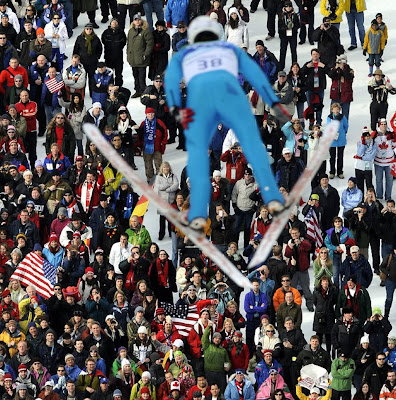 Unnoticed by the vast majority of those watching these winter games is that not one woman will have descended down either of the ski jump hills in competition.
As Gregor Schlierenzauer of Austria completed the team ski jump competition today, one of the rare sour tastes of this Winter Olympics was left in the mouth
His soaring 146.5m jump (the longest of the competition which yielded 145.2 pts) was enough to earn Austria the gold medal.
His soaring 146.5m jump (the longest of the competition which yielded 145.2 pts) was enough to earn Austria the gold medal.
But why should men be the only ones permitted to celebrate their great achievements in this event (and the nordic combined, of which ski jumping forms one half)?
Especially when considering the fact that it is a woman (Lindsay Van) who holds the record jump off the normal hill at Whistler ski park.
USA's Johnny Spillane won silver in the nordic combined competition.
And perhaps more importantly, should a body such as the International Olympic Committee be able to ride roughshod over the host nation's entire legal system?
Because that is exactly what was allowed to happen.
Illegal
The Vancouver Olympics were supposed to be games of equality, in a nation that possesses a specific clause about gender discrimination in its charter of rights and freedoms, and when a British Colombia judge ruled that the action to exclude women from the ski jump competition was indeed illegal under Canadian law, there appeared to be a glimmer of hope.
But that hope was quickly extinguished when the court added that the law didn't apply to an international body such as the IOC.
All that belief and integrity might as well have been thrown to the four winds from the summit of the large hill at Whistler.
There is not a lack of interest, or an absence of willing competitors.
It is down to the stubbornness and commercial minded cynicism of the Vancouver Organising Committee and IOC, and a lack of strength in the Canadian court system to hold both these bodies to account to its national laws.
Excuses
These organisations, it appears, would rather include newer events that have fewer participants but a greater marketing potential, than address a very simple question.
Excuses ranging from the short-sighted (limited space in the athletes' village) to the downright bizarre (female bodies not being suitable for ski jumping) have been used but none satisfy the argument.
The female ski jumpers have been trying to achieve this goal since 1998, and now have their own tour and World Championship, but with the next Olympics in the very un-feminist Russia, they maybe forced to wait until 2018 for their first Olympic contest.
That would be a real leap of faith.
Williams win brings British respect and pride back to Olympics
 Fifty-four seconds after leaving the Whistler sliding centre’s summit for her fourth and final skeleton run, Amy Williams had re-written more than just record books.
Becoming the first individual British athlete in 30 years to claim a Winter Olympic gold medal was impressive enough – she also added the track record along the way - but silencing the national press was an even greater achievement.
And compatriate Shelly Rudman’s rapidly improving times meant that had the competition continued for another slide or two, the country could have celebrated a pair of athletes atop the podium.
However, the silver medalist from four years ago was forced to settle for sixth after producing the fastest descent down the 1km long course in the final round.
It’s noticeable that the events of that Friday night in western Canada marked something of a sea-change in the coverage from the vast majority of the UK press towards these Vancouver Games.
Prior to that, and indeed as long ago as the days leading up to the opening ceremony, much of the reporting had been negative and belittling, with backhanded criticisms ranging from the organizing committee, the (unfortunately) unseasonably warm weather, to even the sports on show.
This last one is perhaps the most concerning, as by showing a flagrant disregard for the merits of ski-jumping, luge, or cross-country skiing, the press are illustrating an equal contempt for the athletes, coaches and significant others who dedicate their time to the training and hard-work that winning a gold medal takes.
DISTASTEFUL
This is unfortunately a distasteful trend for the media which must be un-learnt before the Olympics come-a-calling to London in 2012.
Significant criticism has come towards the host nation’s “Own the podium” aim, but there has been little outcry at the calls from various prominent politicians and athletes for a similar strategy to provide a record haul of British medals two years hence.
Indeed, contrarily this is often supported by the press as something that is needed to make the games a success.
There is no doubt that aspects of every major event, including this present one in British Columbia, require scrutiny and criticism, but just to do so because your country has limited success in the disciplines involved is simply not a good enough excuse.
Why not try fostering an atmosphere of support and pride helping the athletes to succeed, rather than making it appear against the odds or as a silly novelty that will be forgotten about for the next three-and-a-half years.
Maybe that way, in four years time we will actually be able to talk up our athletes chances of bringing medal success.
Friday, February 12, 2010
Ajax boost title hopes with vital victory
 Ajax 3 – 0 FC Twente:
Goals from three different players reinvigorated Ajax’s Eredivisie title challenge as they eventually eased to a comfortable win over FC Twente.
Instead, De Zeeuw’s low skidding drive opened the scoring on 22 minutes, squeezing in at the far post, past a slow to react Sander Boschker in the visitor’s goal.
And Pantelic bundled in a second shortly before halftime after a beautiful swerving effort from captain Luis Suarez crashed against a post.
That gave Martin Jol’s team a commanding but scarcely deserved lead at the break, to which they added as Dennis Rommedahl lashed home to finish off a sustained spell of pressure fifteen minutes from time.
By now Ajax were in full cruise control and the influential Suarez should have already been on the scoresheet, but his effort was incorrectly ruled offside.
Wasted Chances
Steve McClaren’s side deserved that slice of luck, which otherwise appeared to desert them for much of the match as both goalkeeping and finishing let them down.
"The first goal was crucial," McClaren said.
"We had some glorious chances. The way we played in the first 20 minutes until they scored the first goal was very very good, but they improved and we went down, which was disappointing.
"The game hinged on Ajax scoring goals fom nothing, which they did and we didn't, so we don't deserve to win the game," he added.
Indeed it was the visitors who had looked the more likely to score in the early going.
After Pantelic’s flick-on brought a sharp low save from Boschker just two minutes in, they dominated as Ajax’s defensive nerves were exposed.
After Pantelic’s flick-on brought a sharp low save from Boschker just two minutes in, they dominated as Ajax’s defensive nerves were exposed.
However, both Blaise Nkufo and his strike partner Kenneth Perez twice failed to capitalize on defensive lapses, having been set free by incisive midfield passing.
Bryan Ruiz and Chelsea-loanee Miroslav Stoch looked particularly dangerous on the flanks, and their darting runs and nimble footwork continuted to trouble the Ajax backline throughout, but unfortunately for McClaren's men, the strike duo just couldn't find the target from those openings.
As so often happens though, Twente were left to rue those missed opportunities, although they did almost sneak a consolation at the death, but Perez’s curling free-kick smacked against a post and was cleared.
Going for Gold
The hopes of a nation are riding on the shoulders of 23 athletes as the 2010 Winter Olympics start today in Vancouver.
That’s not the total number of competitors Great Britain is sending to western Canada but the host nation’s men’s ice hockey squad.
For Canadian ice hockey, read English football, only colder, more physical and more dedicated.
Many young Canadians grow up playing hockey on homemade backyard rinks in temperatures well below freezing.
And that’s just the start.
If they work hard enough, are determined enough, and more importantly lucky enough to be blessed with some talent on skates, they will soon be playing their way through the junior ranks.
And at just 16-years-old those kids can be playing in front of National Hockey League sized crowds.
 It’s a telling statement that, as Boris Johnson, the mayor of London, performed a good luck Vancouver ceremony with James Wright, Canadian high commissioner to the United Kingdom, the pair crossed hockey sticks in Trafalgar Square.
Not crossed ski poles, or sitting in a bobsleigh, but hockey sticks.
Canada will undoubtedly be near the summit of the final medal table, but for many who reside north of the 49th parallel, the nation’s success will be based solely on the performance of one team.
There are plenty of other medal hopes.
Howard Martin and Cheryl Bernard will be favourites to lead their teams to curling gold, Manuel Osbourne-Paradis and Erik Guay are medal hopes in downhill skiing, with the freestyle skiing and figure skating teams expecting to make the podium as well.
But it will all come back to the “good old hockey game.”
It may seem unfair to place such huge pressure on only one team for one medal, but it is just a fact of life for Canadians.
That’s not the total number of competitors Great Britain is sending to western Canada but the host nation’s men’s ice hockey squad.
For Canadian ice hockey, read English football, only colder, more physical and more dedicated.
Many young Canadians grow up playing hockey on homemade backyard rinks in temperatures well below freezing.
And that’s just the start.
If they work hard enough, are determined enough, and more importantly lucky enough to be blessed with some talent on skates, they will soon be playing their way through the junior ranks.
And at just 16-years-old those kids can be playing in front of National Hockey League sized crowds.
 It’s a telling statement that, as Boris Johnson, the mayor of London, performed a good luck Vancouver ceremony with James Wright, Canadian high commissioner to the United Kingdom, the pair crossed hockey sticks in Trafalgar Square.
Not crossed ski poles, or sitting in a bobsleigh, but hockey sticks.
Canada will undoubtedly be near the summit of the final medal table, but for many who reside north of the 49th parallel, the nation’s success will be based solely on the performance of one team.
There are plenty of other medal hopes.
Howard Martin and Cheryl Bernard will be favourites to lead their teams to curling gold, Manuel Osbourne-Paradis and Erik Guay are medal hopes in downhill skiing, with the freestyle skiing and figure skating teams expecting to make the podium as well.
But it will all come back to the “good old hockey game.”
It may seem unfair to place such huge pressure on only one team for one medal, but it is just a fact of life for Canadians.
Wednesday, February 10, 2010
HMRC v Football Clubs - postponed
A brief update from those court cases earlier today.
Portsmouth now appear to be treading on very thin ice, although there is still a glimmer of hope that they may survive.
Pompey were granted just seven days to prove they will be able to make a payment schedule for the HMRC to prove the ability to pay their debts.
According to the BBC: Court registrar Christine Derrett said she feared the company would continue to trade and build up more debts that would not be paid.
However, both Cardiff City and Southend United are able to breath a bit easier, having earned a 28-day reprieve to get their financial affairs in order, or at least get in a place to pay their tax bills.
It seems the payments these clubs have either made or are set ot make in the near future has at least kept the wolf from the door for the time being.
I guess we'll have to wait another seven or 28 days to get the final decisions in this long running saga.
Portsmouth now appear to be treading on very thin ice, although there is still a glimmer of hope that they may survive.
Pompey were granted just seven days to prove they will be able to make a payment schedule for the HMRC to prove the ability to pay their debts.
According to the BBC: Court registrar Christine Derrett said she feared the company would continue to trade and build up more debts that would not be paid.
"I am very concerned about the financial status of this company," she said. "It seems to me there's a very real risk that this company is undoubtedly trading while it is insolvent.
"I'm obviously conscious that, by making a winding-up order, it would have very severe consequences not only for the company as a business but for the supporters themselves, but that's not a consideration that I strictly take into account."
It also seems the situation is even worse than many feared, with the club not only owing the estimated £7m in VAT, but a further £4.7m in PAYE and National Insurance, which was not included in this process.However, both Cardiff City and Southend United are able to breath a bit easier, having earned a 28-day reprieve to get their financial affairs in order, or at least get in a place to pay their tax bills.
It seems the payments these clubs have either made or are set ot make in the near future has at least kept the wolf from the door for the time being.
I guess we'll have to wait another seven or 28 days to get the final decisions in this long running saga.
Cup finalists face fight for their lives
Just 21 months ago Portsmouth and Cardiff City faced each other in front of a packed Wembley Stadium and worldwide television audience in the FA Cup Final.
Today, in a cruel twist of fate they will both appear before the same court just minutes apart in a battle far more important to their thousands of fans than victory on that Saturday in May 2008.
Defeat on this occasion could lead to one or even both clubs to fall into administration, and in a worst case scenario, to be wound up altogether.
The opponent this time is none other than Her Majesty, or rather Her Majesty’s Revenue and Customs, who are trying to recoup millions of pounds in unpaid taxes from the two clubs.
It’s estimated that more than 100 million people around the world watched Portsmouth lift the famous trophy after a 1-0 win, but since that highlight, fortunes have turned for the worse.
The south coast club faces estimated debts of £60m, is already on their fourth owner of a season that has barely passed its mid-point, and lies bottom of the Premier League staring at the near certainty of relegation to the Championship.
Meanwhile Cardiff, who currently lie a very respectable fourth place in that Championship, are thought to owe around £30m, with HMRC targeting £2.7m of that total debt today.
While both clubs can put much of their ills down to poor ownership decisions that some may call downright financial mismanagement at boardroom level, this is a trend that is fast becoming alarming in its frequency.
Already this season, Crystal Palace, one of the Welsh club’s Championship rivals, have been placed into administration, while League One Southend United will also face a winding-up petition.
There have been 53 professional club administrations since 1992, and that date is more than a coincidence.
It marks the year football entered its new era with the breakaway of the country’s top division and subsequent formation of the Premier League.
With this new league came new money from massive television and sponsorship contracts that brought more matches into more homes, and even to a global audience.
However, this new found wealth has meant that many clubs are living off vast amounts of borrowed cash, paying vastly inflated transfer fees and wages for players in a bid to reach the Premier League promised land where the sport is paved with gold.
Unfortunately, as Dick Whittington discovered on his arrival in London, this is often not the case.
Few teams manage to reach the giddy heights, and even one season of failure can lead to the club’s financial ruin.
So common has this occurrence now become, the sports’ powers have had to introduce football related penalties in an attempt to ensure clubs live within their means.
Crystal Palace have already suffered a ten-point penalty alongside the uncertainty of finding new owners, while previous Premier League regulars Southampton began this campaign in League One with a similar deduction following their troubles last term.
HMRC has begun taking a harder line with football clubs that fall into debt after losing vast sums in overdue tax revenue thanks to this rapid increase in administrations.
A clause of the administration process determines that players must be paid first and in full from any monies available, often meaning that other creditors are left high and dry, receiving only a few pennies from each pound owed.
This has resulted in a big hole often being left in the tax purse, and so the agency has decided to start taking preemptive action in an attempt to recoup all it is owed, rather than wait for the remaining crumbs.
It seems Southend and Cardiff may have some chance of meeting Her Majesty’s demands as eleventh hour bids for cash are pulled together, but for Portsmouth the signs are bleaker, and the club’s survival may come down to the court granting a stay of execution.
Today, in a cruel twist of fate they will both appear before the same court just minutes apart in a battle far more important to their thousands of fans than victory on that Saturday in May 2008.
Defeat on this occasion could lead to one or even both clubs to fall into administration, and in a worst case scenario, to be wound up altogether.
The opponent this time is none other than Her Majesty, or rather Her Majesty’s Revenue and Customs, who are trying to recoup millions of pounds in unpaid taxes from the two clubs.
It’s estimated that more than 100 million people around the world watched Portsmouth lift the famous trophy after a 1-0 win, but since that highlight, fortunes have turned for the worse.
The south coast club faces estimated debts of £60m, is already on their fourth owner of a season that has barely passed its mid-point, and lies bottom of the Premier League staring at the near certainty of relegation to the Championship.
Meanwhile Cardiff, who currently lie a very respectable fourth place in that Championship, are thought to owe around £30m, with HMRC targeting £2.7m of that total debt today.
While both clubs can put much of their ills down to poor ownership decisions that some may call downright financial mismanagement at boardroom level, this is a trend that is fast becoming alarming in its frequency.
Already this season, Crystal Palace, one of the Welsh club’s Championship rivals, have been placed into administration, while League One Southend United will also face a winding-up petition.
There have been 53 professional club administrations since 1992, and that date is more than a coincidence.
It marks the year football entered its new era with the breakaway of the country’s top division and subsequent formation of the Premier League.
With this new league came new money from massive television and sponsorship contracts that brought more matches into more homes, and even to a global audience.
However, this new found wealth has meant that many clubs are living off vast amounts of borrowed cash, paying vastly inflated transfer fees and wages for players in a bid to reach the Premier League promised land where the sport is paved with gold.
Unfortunately, as Dick Whittington discovered on his arrival in London, this is often not the case.
Few teams manage to reach the giddy heights, and even one season of failure can lead to the club’s financial ruin.
So common has this occurrence now become, the sports’ powers have had to introduce football related penalties in an attempt to ensure clubs live within their means.
Crystal Palace have already suffered a ten-point penalty alongside the uncertainty of finding new owners, while previous Premier League regulars Southampton began this campaign in League One with a similar deduction following their troubles last term.
HMRC has begun taking a harder line with football clubs that fall into debt after losing vast sums in overdue tax revenue thanks to this rapid increase in administrations.
A clause of the administration process determines that players must be paid first and in full from any monies available, often meaning that other creditors are left high and dry, receiving only a few pennies from each pound owed.
This has resulted in a big hole often being left in the tax purse, and so the agency has decided to start taking preemptive action in an attempt to recoup all it is owed, rather than wait for the remaining crumbs.
It seems Southend and Cardiff may have some chance of meeting Her Majesty’s demands as eleventh hour bids for cash are pulled together, but for Portsmouth the signs are bleaker, and the club’s survival may come down to the court granting a stay of execution.
Monday, November 23, 2009
Murdoch's Microsoft Madness
Following on from my last post, this news comes hot on the heels of that.
While I understand, and almost commend Rupert Murdoch for his continued attempts to make money from online content, I think he's missing the point a bit.
Firstly, Bing is quite possibly the most horrible search engine to ever grace the world wide web. Bing sprang up from the ruins of msn's search, which itself was hideous and irritating to use. There are few, if any people who use it as a search engine of preference, and so his target market is far smaller than could otherwise be reached.
This would then, of course, react on the advertising rates News International could charge (lose about a quarter of your readers - online or in print) and your advertisers will notice, and not be so keen to part with large volumes of cash.
Therefore, any agreement Murdoch were to strike with Bing would need to be big enough to cover these losses BEFORE making a profit. However, he then procceds to shoot himself in the foot by saying: "If they (Microsoft) were to pay everybody for everything they took, from every newspaper in the world and every magazine they wouldn't have any profits left."
Nothing like identifying your market and knowing how to extract as much from tham as possible is there?
Microsoft obviously hopes that by simply sticking a few bits of "exclusive" news content on their site, people will flock there in their droves.
The problem being that if Bing is to promote the stories at the top of their pages (rather like sponsored current links) how many people really pay attention to those, or trust that the content being provided there if trustworthy and impartial.
This point maybe the only potential victory for Murdoch in this plan. It's far more likely that people would simply go direct to the newspaper website - or even miss it altogether.
Like it or not, we are addicted to Google. Not because of it's huge marketing budget, or it's recognisable brand, but because it actually works. When you search for something, it pretty well gets you it straight away.
This is something Bing can't compete with and, sooner or later, Murdoch will have to admit he can't either.
While I understand, and almost commend Rupert Murdoch for his continued attempts to make money from online content, I think he's missing the point a bit.
Firstly, Bing is quite possibly the most horrible search engine to ever grace the world wide web. Bing sprang up from the ruins of msn's search, which itself was hideous and irritating to use. There are few, if any people who use it as a search engine of preference, and so his target market is far smaller than could otherwise be reached.
This would then, of course, react on the advertising rates News International could charge (lose about a quarter of your readers - online or in print) and your advertisers will notice, and not be so keen to part with large volumes of cash.
Therefore, any agreement Murdoch were to strike with Bing would need to be big enough to cover these losses BEFORE making a profit. However, he then procceds to shoot himself in the foot by saying: "If they (Microsoft) were to pay everybody for everything they took, from every newspaper in the world and every magazine they wouldn't have any profits left."
Nothing like identifying your market and knowing how to extract as much from tham as possible is there?
Microsoft obviously hopes that by simply sticking a few bits of "exclusive" news content on their site, people will flock there in their droves.
The problem being that if Bing is to promote the stories at the top of their pages (rather like sponsored current links) how many people really pay attention to those, or trust that the content being provided there if trustworthy and impartial.
This point maybe the only potential victory for Murdoch in this plan. It's far more likely that people would simply go direct to the newspaper website - or even miss it altogether.
Like it or not, we are addicted to Google. Not because of it's huge marketing budget, or it's recognisable brand, but because it actually works. When you search for something, it pretty well gets you it straight away.
This is something Bing can't compete with and, sooner or later, Murdoch will have to admit he can't either.
Friday, November 13, 2009
Will paying for online articles be the saviour of newspapers?
Without doubt the biggest challenge facing the publishing world at the moment is the continued boom of free online access to content. While audiences my feel they have the right to view anything and everything online without charge, this is a model that is quite simply unsustainable and does not reward the journalists who produce it.
Yes, with the arrival of the global network there will always be someone somewhere to describe the events happening on their doorstep and disseminate it through whichever medium they choose. But where do the audience find the authority that the mass-media provide to trust this source?
Since the penny dropped over a decade ago that the world wide web was hear to stay, and every organisation - media or not - was going to have a presence on this new space, there has been a continued growth in the volume, variety and quality of content being made freely available.
However, this has caused the longstanding and usually trusted mass-media organisations one heck of a problem, which they were rather slow to catch on to.
In the rush to become the biggest - and therefore the best - online newspaper, publishers threw caution to the wind and made all their published content freely available on their websites. They even started adding extra features and elements to their sites that could only be found online.
The information age had truely arrived, and the public took advantage.
It`s hardly surprising that instead of buying daily newspapers and periodical magazines, people started logging on to find out today's breaking news for free, rather than reaching into their pockets every morning to purchase yesterday's news. As a result, newspapers shed readers like sheep do fleeces in summer.
To compound this, newspapers suffered a double hit. Not only were they facing falling sales income, but as the circulations dropped, so too did the revenues from advertising that depend on audience figures. This was hard enough to tackle in calm economic seas, but as the recession wind and waves began to blow, advertising took a back seat as companies battened down the hatches to ride out the full force of the storm.
It has become obvious this cannot continue, and newspapers will need to raise serious revenue sums from their websites. The Financial Times and Wall Street Journal already charge subscriptions for access to their content, but these are specific publications, targetting an audience that can afford to pay. Suggestions for subscriptions to websites of mainstream titles have largely been received icily.
But audiences are warming to another idea. Micro-payments.
The reader pays a few pennies for every article read, with the value depending on the type of article, author etc.
This system, if operated correctly, could even save Britain's printed press.
At say, 5p per article, if a person reads ten a day, that equals 50p. Depending on your chosen title, that is anywhere from half to the full cover price of most daily newspapers.
Using this method almost all readers can be satisfied.
Those who want to read just one or two stories that take their interest, whether through searches or news aggregator sites, can do so for a very minor charge; while people who want a fuller look at upto a dozen articles, will pay for about half the cover price.
But the most exciting element comes for those heavy readers, who want to digest the whole paper over breakfast, on the train to work, and then finish off at lunch. They can either buy an online "copy", or even pick up a regular print version for the same price.
Of course there are issues around it to consider, such as updating stories throughout the day on websites. But the theory could see people who would heavily access content only on particular days buying the paper instead to receive all the extra articles in addition to their preferred online stories.
If enacted properly and sensibly, with cross-industry co-operation, it could see the resurgence and re-vitalisation of a once vibrant and dynamic national press.
Yes, with the arrival of the global network there will always be someone somewhere to describe the events happening on their doorstep and disseminate it through whichever medium they choose. But where do the audience find the authority that the mass-media provide to trust this source?
Since the penny dropped over a decade ago that the world wide web was hear to stay, and every organisation - media or not - was going to have a presence on this new space, there has been a continued growth in the volume, variety and quality of content being made freely available.
However, this has caused the longstanding and usually trusted mass-media organisations one heck of a problem, which they were rather slow to catch on to.
In the rush to become the biggest - and therefore the best - online newspaper, publishers threw caution to the wind and made all their published content freely available on their websites. They even started adding extra features and elements to their sites that could only be found online.
The information age had truely arrived, and the public took advantage.
It`s hardly surprising that instead of buying daily newspapers and periodical magazines, people started logging on to find out today's breaking news for free, rather than reaching into their pockets every morning to purchase yesterday's news. As a result, newspapers shed readers like sheep do fleeces in summer.
To compound this, newspapers suffered a double hit. Not only were they facing falling sales income, but as the circulations dropped, so too did the revenues from advertising that depend on audience figures. This was hard enough to tackle in calm economic seas, but as the recession wind and waves began to blow, advertising took a back seat as companies battened down the hatches to ride out the full force of the storm.
It has become obvious this cannot continue, and newspapers will need to raise serious revenue sums from their websites. The Financial Times and Wall Street Journal already charge subscriptions for access to their content, but these are specific publications, targetting an audience that can afford to pay. Suggestions for subscriptions to websites of mainstream titles have largely been received icily.
But audiences are warming to another idea. Micro-payments.
The reader pays a few pennies for every article read, with the value depending on the type of article, author etc.
This system, if operated correctly, could even save Britain's printed press.
At say, 5p per article, if a person reads ten a day, that equals 50p. Depending on your chosen title, that is anywhere from half to the full cover price of most daily newspapers.
Using this method almost all readers can be satisfied.
Those who want to read just one or two stories that take their interest, whether through searches or news aggregator sites, can do so for a very minor charge; while people who want a fuller look at upto a dozen articles, will pay for about half the cover price.
But the most exciting element comes for those heavy readers, who want to digest the whole paper over breakfast, on the train to work, and then finish off at lunch. They can either buy an online "copy", or even pick up a regular print version for the same price.
Of course there are issues around it to consider, such as updating stories throughout the day on websites. But the theory could see people who would heavily access content only on particular days buying the paper instead to receive all the extra articles in addition to their preferred online stories.
If enacted properly and sensibly, with cross-industry co-operation, it could see the resurgence and re-vitalisation of a once vibrant and dynamic national press.
Friday, July 17, 2009
Nice weather for cricket!
I'm actually quite surprised that is was only April when I last added something to this.
So I've now basically finished my course and am in the wonderful job hunting market. Sadly journalism jobs are not that widely available, so it could be a fairly long search, but I'm hopeful.
The course has gone fantastically well, I've got very good marks, and so it's just a matter of time I hope.
If anyone out there reading this (which makes the rather bold presumption that people actually DO read this) has a reporter position they need filling by a keen, hard working, excellent writing and very cheap, newly qualified journalist.... I am available for work ANYWHERE!
Also, I am now on Twitter, and you can follow me HERE.
For those of you who don't know about Twitter, think of it almost as text messaging online... although there are obviously less messages about asking your other half to buy a pint of milk on the way home or to remember to walk the dog.
And following along the twitter line, THIS is a really fascinating site. Apparently the people who run it do so for little or no profit, and just one glance down the postings shows that people do find it unburdening.
And THIS is something else that may help you all realise (if you ahven't already) what is truely valuable in life to you. I defy anybody not to be moved by today's letter.
So I've now basically finished my course and am in the wonderful job hunting market. Sadly journalism jobs are not that widely available, so it could be a fairly long search, but I'm hopeful.
The course has gone fantastically well, I've got very good marks, and so it's just a matter of time I hope.
If anyone out there reading this (which makes the rather bold presumption that people actually DO read this) has a reporter position they need filling by a keen, hard working, excellent writing and very cheap, newly qualified journalist.... I am available for work ANYWHERE!
Also, I am now on Twitter, and you can follow me HERE.
For those of you who don't know about Twitter, think of it almost as text messaging online... although there are obviously less messages about asking your other half to buy a pint of milk on the way home or to remember to walk the dog.
And following along the twitter line, THIS is a really fascinating site. Apparently the people who run it do so for little or no profit, and just one glance down the postings shows that people do find it unburdening.
And THIS is something else that may help you all realise (if you ahven't already) what is truely valuable in life to you. I defy anybody not to be moved by today's letter.
Thursday, April 02, 2009
More of me!
Mansfield Town v Torquay match report.
This was actually a pretty good game, and surprisingly good football despite the near gale blowing down the pitch.
Here
And here's my updates from the Mansfield v Forest Green Rovers game.
Here
I've even managed to get my name in the official club programme for one of the fans interviewing sections I do in there. Not a huge credit.... but it all counts, and they are all gratefully received. Just call me Mr Stag!!!
And last but not least, another version of my Varsity Ice Hockey report. This one was done for Nottingham Trent Students Uni, so I couldn't really go ahead and write "Trent Uni were hammered by their local rivals", it needed a but more *ahem* "spin." Haha!
Here
This week has been another hectic one, as I'm at the Western Mail and South Wales Echo (all one organisation now) on a week's work placement. It started off slow, but has got better and better, and now I'm actually getting a few by-lines as my articles get printed.
I'll try to put as many up here as possible... those that MediaWales decide to put online that is!
This was actually a pretty good game, and surprisingly good football despite the near gale blowing down the pitch.
Here
And here's my updates from the Mansfield v Forest Green Rovers game.
Here
I've even managed to get my name in the official club programme for one of the fans interviewing sections I do in there. Not a huge credit.... but it all counts, and they are all gratefully received. Just call me Mr Stag!!!
And last but not least, another version of my Varsity Ice Hockey report. This one was done for Nottingham Trent Students Uni, so I couldn't really go ahead and write "Trent Uni were hammered by their local rivals", it needed a but more *ahem* "spin." Haha!
Here
This week has been another hectic one, as I'm at the Western Mail and South Wales Echo (all one organisation now) on a week's work placement. It started off slow, but has got better and better, and now I'm actually getting a few by-lines as my articles get printed.
I'll try to put as many up here as possible... those that MediaWales decide to put online that is!
Thursday, March 12, 2009
Busy, busy, busy!
Its been rather busy in "owains-world", and here's just a little of what I've been upto:
Covering the Varsity Ice Hockey match here in Nottingham between Trent University and the University of Nottingham.
I'm really pleased about this as my article made it into the Nottingham Evening Post.
http://www.thisisnottingham.co.uk/panthers/Fifth-time-lucky-University-Nottingham/article-759188-detail/article.html
I've also done some filming work while covering the event as part of my coursework. So you may find me infront of the camera in the future too, not just behind a keyboard!
I'm also continuing my match-day work with Mansfield Town. So if you check their website mansfieldtown.net on a home match day, the chances are you'll be reading me!
http://www.mansfieldtown.premiumtv.co.uk/page/NewsDetail/0,,10325~1582270,00.html
http://www.mansfieldtown.premiumtv.co.uk/page/NewsDetail/0,,10325~1582661,00.html
http://www.mansfieldtown.premiumtv.co.uk/page/NewsDetail/0,,10325~1549003,00.html
http://www.mansfieldtown.premiumtv.co.uk/page/NewsDetail/0,,10325~1535345,00.html
Covering the Varsity Ice Hockey match here in Nottingham between Trent University and the University of Nottingham.
I'm really pleased about this as my article made it into the Nottingham Evening Post.
http://www.thisisnottingham.co.uk/panthers/Fifth-time-lucky-University-Nottingham/article-759188-detail/article.html
I've also done some filming work while covering the event as part of my coursework. So you may find me infront of the camera in the future too, not just behind a keyboard!
I'm also continuing my match-day work with Mansfield Town. So if you check their website mansfieldtown.net on a home match day, the chances are you'll be reading me!
http://www.mansfieldtown.premiumtv.co.uk/page/NewsDetail/0,,10325~1582270,00.html
http://www.mansfieldtown.premiumtv.co.uk/page/NewsDetail/0,,10325~1582661,00.html
http://www.mansfieldtown.premiumtv.co.uk/page/NewsDetail/0,,10325~1549003,00.html
http://www.mansfieldtown.premiumtv.co.uk/page/NewsDetail/0,,10325~1535345,00.html
Subscribe to:
Posts (Atom)


